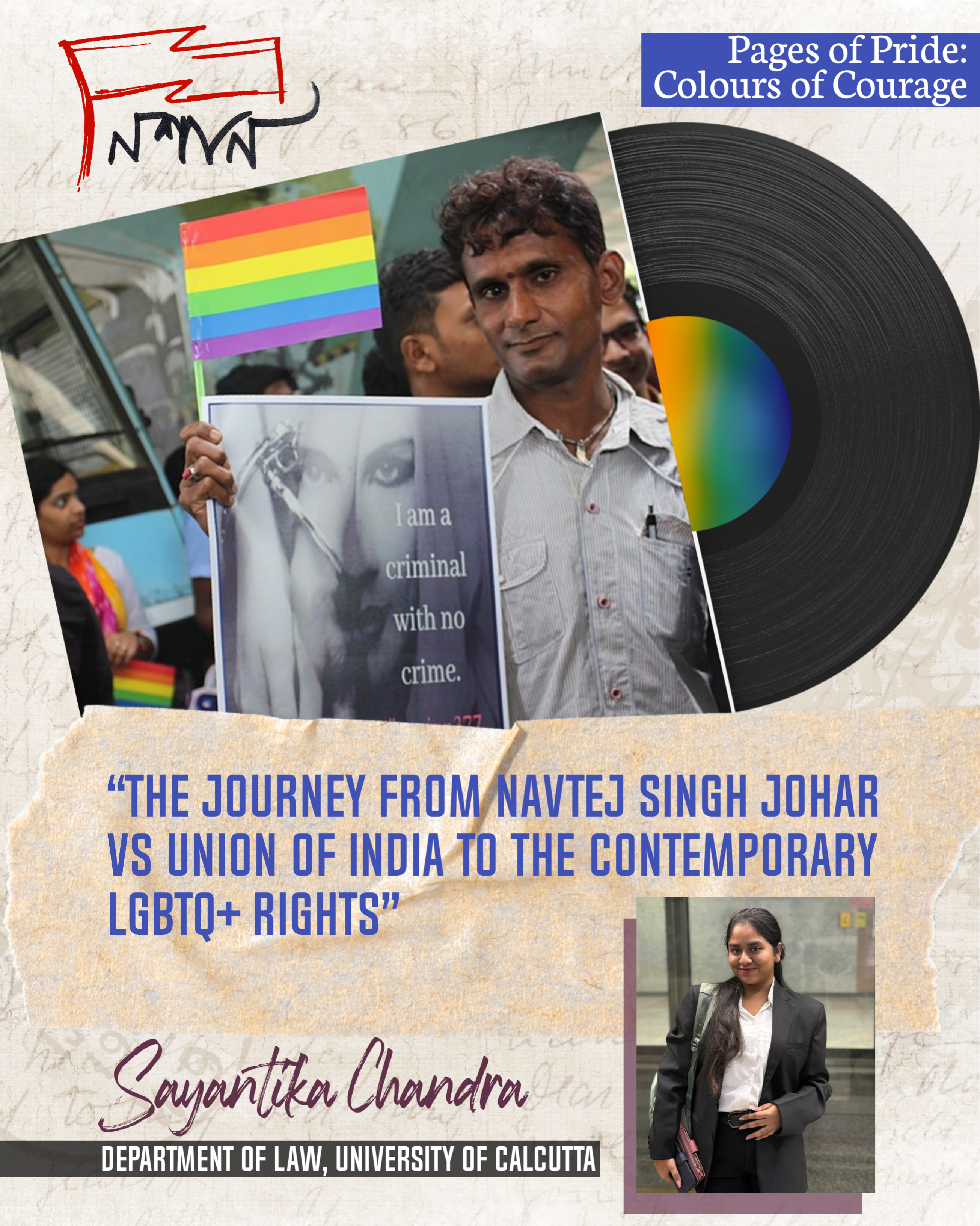
The journey of the struggle of the LGBTQ+ rights has been marked by several judicial battles, social revolution and aspiring constitutional remidies . Navtej singh johar vs the union of India is a landmark case of the supreme court in 2018 which plays a very important role in determining the journey of contemporary LGBTQ rights.
Beginning of the journey of Decrimalising homosexuality:
Section 377 of the Indian penal code ( IPC) was a colonial era law which criminalized sexual acts "against the order of nature". Following the landmark 2018 Supreme Court ruling in Navtej Singh Johar v. Union of India, it is no longer enforceable for consensual adult homosexual relations.
Navtej Singh, the petitioner of the case was a dancer who was recognised as a part of the LGBTQ community. He filed a writ petition in the supreme court in 2016 seeking recognition of sexuality,right to sexual autonomy and right to choice of a sexual partner to be part of the right to life guaranteed by Art. 21 of the Constitution of India and stating that Section 377 of IPC is unconstitutional and intervenes the right to equality before law as per Article 14 of the fundamental rights. He also argued that Section 377 violates
1.Article 15 - protection from discrimination , as it interrupts the sex of a person's sexual partner.
2. Article 19 - Freedom of expression, as it denies one's feeling towards their partners based on homosexuality.
3. Article 21 - right to privacy, as it subjected LGBT people to the fear that they would be humilited because of a certain choice or manner of living.
The petitioner, The Union of India, submitted that it left the question of the constitutional validity of Section 377 to the wisdom of the Court. Some interveners argued against the Petitioner, submitting that the right to privacy was not unbridled, that such acts were derogatory to the “constitutional concept of dignity” , that such acts would increase the prevalence of HIV/AIDS in society, and that declaring Section 377 unconstitutional would be detrimental to the institution of marriage and that it may violate Art. 25 of the Constitution - Freedom of Conscience and Propagation of Religion.
Judgement:
As a result of the following landmark case The Supreme court of India struck down the section 377 of IPC as the choice of sexual partners is personal and unconstitutional and criminalizing queer relationships invades right to privacy, right to equality , freedom of expression and right to protection from discrimination.
The decriminalisation of homosexuality transformed the legal status of the LGBTQ+ association in India. The constant threat of being attacked for the identity they possess is removed and it prescribes a clear message that LGBTQ+ identities are neither immoral nor unlawful. The judgement encouraged more individuals to express their sexuality proudly. Besides , the exposure of media to discussions relating to LGBTQ+ rights and communities have increased, public discussions have become inclusive and awareness regarding this community has become essential. Workplaces, educational institutions and other civil communities are adopting more practices for the welfare of the LGBTQ society. The judgement in the case of Navjot Singh vs the union of India as agreed by the activists was only the first step for decriminalisation and that genuine equality required legal recognition of relationships, protection against discrimination, and access to social benefits.
Case laws relating to homosexuality:
Besides this case there are some other important cases that can be discussed in this context.
- In Supriyo vs Union of India (2023) landmark case, a five-judge Constitution Bench declined to legalize same-sex marriage, ruling that there is no fundamental right to marry under the Constitution and that this requires legislative action by Parliament. However, all five judges unanimously directed the Union Government to form a high-powered committee to address the discrimination faced by queer couples regarding social benefits, joint bank accounts, and insurance.
- In Jane Kaushik v. Union of India (2025) The Supreme Court delivered a watershed judgment addressing the systemic discrimination faced by transgender persons in employment. The Court firmly held that state and private entities must actively translate constitutional equality into reality, taking a strict stance against the termination of transgender employees simply based on their gender identity.
- National Legal Services Authority (NALSA) v. Union of India (2014): A major case for gender identity that established the "third gender" recognition and solidified rights for transgender persons. It laid the foundation for the jurisprudence used in later LGBTQIA+ rights cases.
- Deepika Singh v. Central Administrative Tribunal (2022):The Supreme Court ruled in favor of widening the definition of "family," acknowledging that atypical family units (including same-sex and queer relationships) are deserving of equal protection and social welfare benefits.
In the global context too we find certain precedents regarding the sensitive issues raised by the LGBTQ+ community. - Obergefell v. Hodges (United States, 2015): The United States Supreme Court ruled that the fundamental right to marry is guaranteed to same-sex couples by both the Due Process Clause and the Equal Protection Clause of the Fourteenth Amendment.
- Lawrence v. Texas (United States, 2003):Struck down the sodomy law in Texas, thereby decriminalizing same-sex sexual acts nationwide in the U.S.
- Toonen v. Australia (United Nations Human Rights Committee, 1994): A landmark international human rights decision establishing that laws criminalizing consensual same-sex activity violate the right to privacy and are inherently discriminatory.
Acts for the welfare of the LGBTQ+ community:
The Transgender Persons (Protection of Rights) Act, 2019 recognises the right to self-perceived gender identity, and new identification documents confirming the change of gender can be issued by government agencies once a certificate is provided by a relevant medical official.Transgender citizens have a constitutional right to register themselves under a third gender.
The Transgender Persons (Protection of Rights) Rules, 2020 supplements the 2019 Act by outlining avenues for gender-affirming surgeries at state-run hospitals and various welfare schemes.
Marriage Equality (2023): While the Supreme Court ruled that there is no fundamental right to marry for same-sex couples under current statutory laws, the legal and social battle for marriage, adoption, and civil unions continues.
Crimes relating to homosexuality: In spite of guaranteeing all these rights to the community of LGBTQ+ hardships prevail in their day to day lives.
1. One of the gay cross dressers Rajesh Yadav from Bilaspur Biharwho is 25 years of age has been gangraped many times and is brutally beaten just because of her sexuality.
2. Ayesha Kapoor from Bihar asserted that police come to their house and harass them for money and even sexually abuse them.
3. In 2014, A doctor from Bangalore stated that he had sexual relations with many men and when someone came to know about this, he was extorted the money from.
Conclusion:
Therefore the journey of the LGBTQ+ community marks its beginning from the Navtej Singh vs the Union of India case and has gained relevance and importance all across but there are still some major flaws in the social system as a class of people thus fails to accept the ones who are not like them, which means homosexual. The judiciary tries its level best to keep up equality, the constitution has granted several rights for the welfare of the LGBTQ community but the society still demands improvement in its mindset.Ultimately, the journey from the Navtej Singh Johar judgment to contemporary LGBTQ+ rights marks a profound shift in Indian constitutional jurisprudence, where constitutional morality triumphed over archaic, majoritarian social morality. By recognizing sexual orientation as an inherent and inviolable aspect of the right to life and personal liberty, the Supreme Court ignited a transformative dialogue on civil liberties.