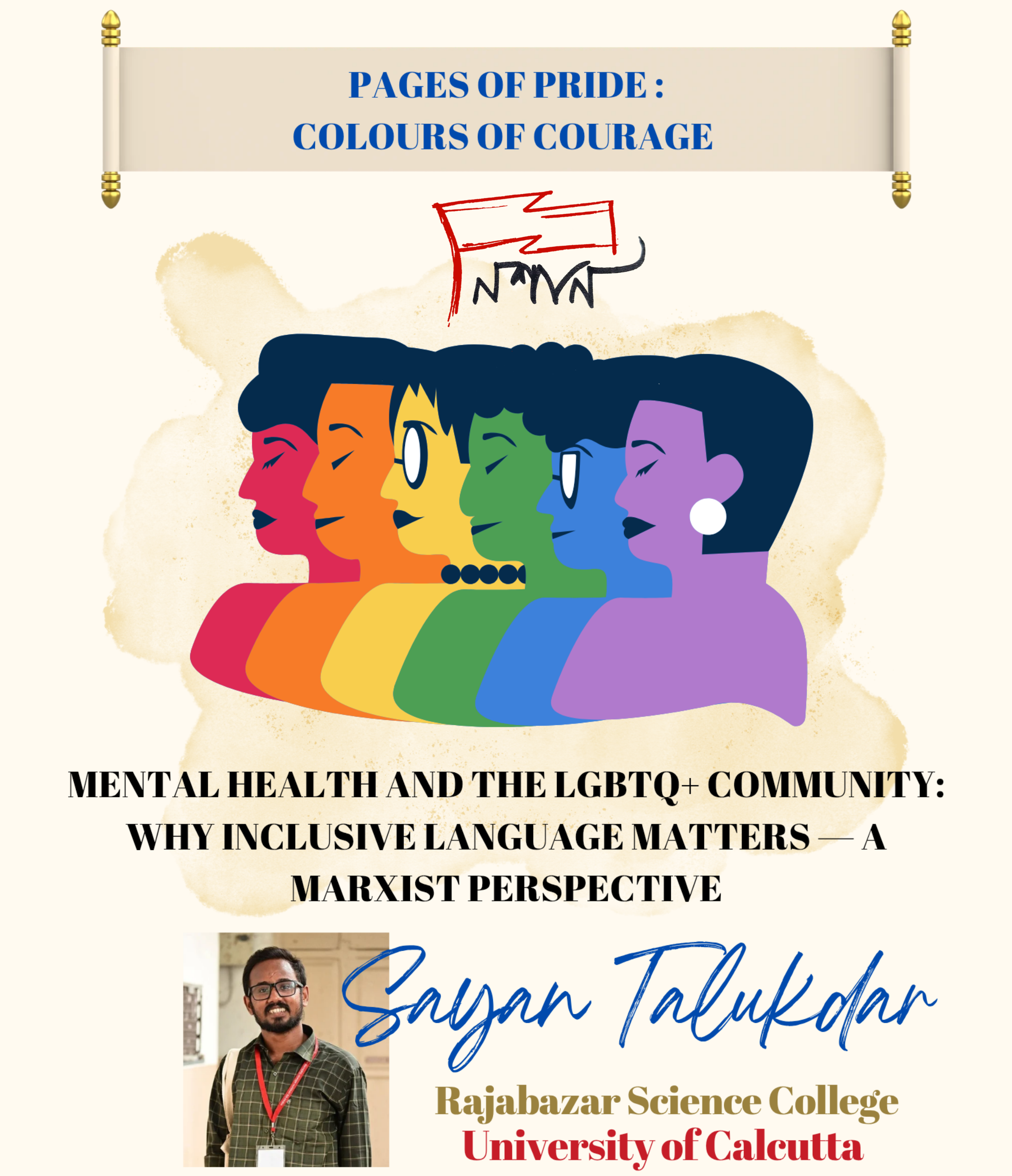
Introduction
Mental health is often discussed as an individual matter. Depression, anxiety, loneliness, and psychological distress are frequently presented as personal struggles disconnected from the social world. Marxists have long challenged this understanding. Human beings do not exist in isolation; they live within specific social, economic, and political structures. Therefore, mental suffering cannot be understood apart from the conditions in which people live.
For LGBTQ+ individuals, mental health is inseparable from the experience of living in a society structured by capitalism, patriarchy, heteronormativity, and class divisions. Higher rates of anxiety, depression, self-harm, and social isolation within LGBTQ+ communities are not products of queer identities themselves. They are consequences of oppression, exclusion, and alienation.
Language occupies a central position in this process. The words used by families, schools, workplaces, media institutions, and the state are never neutral. Language reflects relations of power. It can reinforce systems of domination or contribute to struggles for liberation. Inclusive language therefore should not be understood merely as a question of etiquette. It is part of a broader struggle against social hierarchies that deny people dignity and humanity.
A Marxist analysis allows us to move beyond the liberal framework of "tolerance" and examine how language, mental health, and LGBTQ+ oppression are connected to the material organization of society itself.
Capitalism, Alienation, and Mental Health
Karl Marx argued that capitalism produces alienation. Workers become separated from the products of their labor, from their fellow human beings, and ultimately from their own human potential.
Alienation extends beyond the workplace. Capitalist societies require rigid social norms that help reproduce existing economic relations. The nuclear family, traditional gender roles, and heteronormative expectations become important institutions for maintaining social order.
For LGBTQ+ people, this often means growing up in environments where their identities are considered abnormal, undesirable, or invisible. The resulting psychological burden is not simply personal suffering; it is a manifestation of social alienation.
Marx wrote that human beings are fundamentally social creatures. When society denies recognition to certain identities, it creates conditions under which people become estranged from themselves and others. Feelings of shame, isolation, and self-hatred emerge not from inherent flaws but from oppressive social conditions.
Mental health struggles within LGBTQ+ communities must therefore be understood as products of broader systems of domination rather than individual weaknesses.
Engels, the Family, and the Regulation of Sexuality
In The Origin of the Family, Private Property and the State, Friedrich Engels argued that the modern patriarchal family emerged alongside private property and class society. The family became not merely a space of affection but also an institution responsible for reproducing social norms, inheritance systems, and gender roles. While Engels did not directly discuss LGBTQ+ identities, his analysis helps us understand why societies often police sexuality and gender expression so intensely.
For many LGBTQ+ individuals, the family is the first place where they encounter the contradiction between their inner self and social expectations. Most queer people do not wake up one day and consciously decide that they are different. Rather, many describe a long and often confusing journey of self-discovery.
A young boy may notice that he does not feel the same way as other boys around him. A girl may struggle to understand why she cannot relate to the expectations imposed upon her as a "proper girl." A transgender person may experience discomfort with the gender assigned to them long before they possess the vocabulary to describe those feelings. In childhood and adolescence, many LGBTQ+ individuals simply know that something feels different, even if they cannot yet name it. This period of uncertainty is often accompanied by loneliness. The individual sees everyone around them fitting into expected categories while they themselves remain unable to fully understand their own experiences. When society offers little language or representation through which they can recognize themselves, confusion frequently turns into anxiety.
The situation becomes even more difficult when self-recognition finally arrives. Discovering one's identity is often described as liberating, but liberation is immediately confronted by the reality of social acceptance. Many LGBTQ+ individuals face rejection from family members, ridicule from classmates, isolation from peers, and hostility from their broader social environment.
The fear of losing parental love, friendship, or social belonging creates immense psychological pressure. A young person may begin concealing their identity, constantly monitoring their speech, gestures, clothing, and behavior in order to avoid suspicion. Such self-surveillance is emotionally exhausting. What appears from the outside as silence often conceals an intense internal struggle. From a Marxist perspective, this suffering is not merely personal. It is produced by social institutions that enforce rigid norms regarding gender, sexuality, and family life. The frustration, depression, and alienation experienced by many LGBTQ+ individuals are rooted not in their identities but in the refusal of society to accept diverse forms of human existence.
Inclusive language within families therefore carries enormous significance. The use of affirming language, chosen names, and respectful communication can become acts of recognition that reduce alienation and create conditions in which individuals can develop freely. In this sense, language becomes part of the broader struggle against oppressive social relations.
Gramsci and Cultural Hegemony
Antonio Gramsci's concept of cultural hegemony is particularly useful for understanding why exclusionary language persists.
Gramsci argued that ruling classes maintain power not only through economic control but also through cultural institutions such as schools, media, religion, and family structures. These institutions shape what people perceive as normal, natural, and common sense.Heteronormativity functions as a form of cultural hegemony. Society teaches individuals to assume that everyone is heterosexual and cisgender unless stated otherwise.
Inclusive language disrupts this assumption. By recognizing diverse identities, it challenges dominant narratives about what constitutes a legitimate human life.This is why debates about pronouns, names, and representation often become politically charged. They are not merely linguistic disputes; they are struggles over whose experiences are recognized as socially valid.
The Politics of Recognition and Mental Health
Human beings require recognition to flourish. Marx emphasized that individuality develops through social relations. We become ourselves through interaction with others.When LGBTQ+ individuals are denied recognition, the consequences extend far beyond hurt feelings. Persistent invalidation contributes to anxiety, depression, and social withdrawal.
Leslie Feinberg argued that language is often a site of struggle between oppression and liberation. The refusal to acknowledge a person's chosen name or identity communicates that their existence is illegitimate.
Inclusive language functions as a form of recognition. It affirms that LGBTQ+ individuals are not deviations from humanity but fully human participants in society.Such recognition has profound implications for mental health because it reduces the alienation produced by exclusion.
Capitalism and the Commodification of Inclusion
A Marxist perspective also requires critical examination of contemporary forms of inclusion.
Corporations increasingly adopt LGBTQ+ imagery, especially during Pride Month. Rainbow logos appear on products, advertisements, and social media campaigns. Yet symbolic inclusion often coexists with exploitative labor practices and unequal social relations.This phenomenon illustrates capitalism's ability to commodify resistance.
The language of diversity can become a marketing strategy rather than a commitment to liberation. Mental health challenges within LGBTQ+ communities cannot be solved through corporate branding alone.Real inclusion requires material changes: accessible healthcare, housing security, employment protections, educational opportunities, and social acceptance.Inclusive language is necessary but insufficient. It must be connected to broader struggles for social and economic justice.
Queer Liberation and Collective Struggle
Marxism emphasizes collective rather than individual solutions to social problems.
Mental health interventions are important, but they cannot replace social transformation. If oppression produces suffering, then liberation requires changing the conditions that generate oppression.Queer liberation is therefore inseparable from struggles against capitalism, patriarchy, caste oppression, racism, and other forms of domination.
Alexandra Kollontai envisioned a society in which human relationships could develop freely without the constraints imposed by economic dependence and social hierarchy. Such a vision remains relevant today.Inclusive language contributes to this struggle by creating spaces where people can exist authentically without fear of ridicule or exclusion.
Youth Movements, LGBTQ+ Visibility, and the Struggle for Recognition
Throughout history, moments of youth rebellion and democratic struggle have often created spaces where marginalized voices can become visible. Contemporary youth-led protest movements have similarly provided opportunities for LGBTQ+ individuals to participate in broader struggles against injustice, inequality, and authoritarianism.
Many queer students and young activists find themselves drawn toward democratic and progressive movements because they recognize parallels between their own experiences of exclusion and wider struggles against oppression. Participation in such movements allows them to connect questions of identity with questions of social justice, education, employment, democracy, and human rights.
However, participation does not automatically eliminate prejudice. Even within movements that challenge dominant power structures, LGBTQ+ individuals often continue to encounter stereotypes, dismissive attitudes, and ridicule. Media representations frequently trivialize queer participation in political movements, reducing complex political actors to objects of mockery rather than engaging seriously with their ideas and contributions.
Conservative political forces and sections of right-wing media often portray LGBTQ+ demands as distractions from "real issues" or as foreign influences disconnected from local realities. Such narratives attempt to separate struggles for social justice from struggles for gender and sexual liberation, despite the fact that both emerge from experiences of inequality and exclusion.
A Marxist analysis suggests that liberation movements cannot be selective. A democratic movement that ignores caste oppression, patriarchy, religious discrimination, or queer oppression remains incomplete. The struggle for human emancipation requires solidarity among all oppressed groups.
Hindutva, Social Hierarchy, and LGBTQ+ Exclusion
Many progressive scholars and activists have argued that contemporary Hindutva politics frequently draws upon social ideas that emphasize hierarchy, conformity, and traditional social roles.
Within this framework, gender and sexuality are often understood through highly restrictive norms. The ideal citizen is imagined through a narrow model of family life, masculinity, femininity, and social behavior. Those who fall outside these expectations may be portrayed as abnormal, immoral, or culturally alien.
Critics have argued that such perspectives reinforce structures of social hierarchy that have historically marginalized various groups, including women, lower castes, religious minorities, and LGBTQ+ individuals. When social legitimacy is tied to conformity, those whose identities challenge established norms often face exclusion.
The consequences are not merely political. They are psychological. Constant exposure to narratives that deny or stigmatize one's identity can contribute to anxiety, self-doubt, and emotional distress. For LGBTQ+ individuals, the struggle is therefore not only for legal rights but also for social recognition and human dignity.
LGBTQ+ Organizing in Public Universities
Public universities have historically served as important spaces for critical thought, democratic debate, and social movements. They are often among the first institutions where LGBTQ+ students find opportunities to organize collectively, discuss their experiences openly, and build supportive communities.
Yet the process of creating queer spaces within universities is rarely easy.
Student activists frequently confront administrative indifference, bureaucratic obstacles, and social resistance. Requests for discussion forums, awareness campaigns, pride events, gender-neutral facilities, or institutional recognition may encounter delays or outright opposition. Even when formal permission is granted, organizers often face hostility from sections of the student body who view LGBTQ+ issues as unnecessary or controversial.
Many queer students therefore find themselves fighting two battles simultaneously. On one hand, they must navigate the academic pressures faced by all students. On the other, they must struggle for the basic right to exist visibly within the university community.
The emotional burden of this struggle is significant. Every poster campaign, public meeting, awareness event, or protest requires courage because visibility itself can invite harassment and ridicule. Yet these efforts are essential because they challenge the silence surrounding queer existence.
From a Marxist perspective, universities are sites of ideological struggle. They are places where dominant ideas are reproduced but also where those ideas can be challenged. LGBTQ+ student movements play a crucial role in expanding democratic space within educational institutions. Their demands are not simply identity-based claims; they are demands for recognition, equality, and participation in collective intellectual life.
The struggle for inclusive campuses is therefore part of the broader struggle for democratic education itself. A truly democratic university must create conditions in which every student can learn, organize, express themselves, and develop their full human potential without fear of discrimination or exclusion.
Conclusion
From a Marxist perspective, the relationship between mental health and LGBTQ+ experiences cannot be reduced to individual psychology. It is rooted in social structures that produce alienation, exclusion, and inequality.
Language is one of the arenas where these structures operate. Words can reinforce oppression or challenge it. Inclusive language matters because recognition matters. Recognition matters because human beings are social beings whose well-being depends upon dignity, belonging, and participation in collective life.
The struggle for inclusive language is therefore not merely a cultural issue. It is part of a broader struggle for human emancipation. A society committed to genuine freedom must reject all forms of oppression and create conditions in which every individual—regardless of gender identity or sexual orientation—can develop their full human potential.
As Marx envisioned, the goal remains a society in which the free development of each is the condition for the free development of all.